

Last updated: January 2, 2026
TL;DR
No general price match: Amazon’s official policy says, We don’t offer price matching Amazon Customer Service. That means Amazon won’t match Walmart, Target, Best Buy — or even yesterday’s Amazon price.
What they actually honor: The only formal “guarantee” is the Pre‑Order Price Guarantee (if the price drops between order and release, you’re charged the lowest price).
What still works when a price drops after purchase: (1) Return & re‑buy within the return window; (2) politely ask Customer Service for a one‑time courtesy credit (discretionary and not promised — success varies and is often anecdotal, see community reports).
“Tell us about a lower price” is feedback, not a match — it may influence pricing but does not adjust your order. See the feature’s description here.
A‑to‑z Guarantee ≠ price matching: It protects orders (delivery, condition, third‑party disputes), not price differences. Overview from Amazon here.
Looking for the full 2026 policy and scripts? See our Amazon Price Match Guide — 2026 Policy & How It Really Works
Amazon’s Price Match Policy
Amazon publishes a dedicated help page titled Price Matching that states, We don’t offer price matching. In practice, this means there is no store‑wide commitment to match a competitor’s price or to refund the difference if Amazon’s own price drops after you purchase. This is true across everyday shopping and major sales events alike.
Historically, Amazon experimented with price protection for select categories (notably TVs), but that ended years ago — coverage from 2016 documented the change. Since then, Amazon has leaned on dynamic pricing and returns to handle post‑purchase pricing issues, rather than a formal price match policy.
What the “Amazon Price Match Guarantee” Really Means
The phrase “amazon price match guarantee” is frequently used online, but the only official guarantee Amazon describes is the Pre‑Order Price Guarantee. Amazon’s explanation is clear: You’ll pay the lowest price offered between your order and the release date. This applies only to qualifying pre‑order items that explicitly display the guarantee on their product pages.
Pre‑Order Price Guarantee: scope & limits
Only applies to items that show the guarantee language at checkout/product page.
Covers price changes between the moment you place the order and the item’s release or delivery date (depending on region).
Does not apply to ordinary, already‑released items you buy today and see cheaper tomorrow.
If you see blogs claim a blanket amazon price match guarantee for all purchases, that’s incorrect. The guarantee is a narrow pre‑order benefit, not a general post‑purchase policy.
What Amazon Actually Honors in 2026
1) Pre‑Order Price Guarantee
As noted, this is the only formal, site‑wide guarantee related to prices. If the item qualifies and the price falls between your pre‑order and release, Amazon charges you the lowest price automatically. See the help page here.
2) “Tell Us About a Lower Price” (Feedback, not a match)
Many product pages include a “Tell us about a lower price” link. Per Amazon, this feature simply collects data about cheaper offers elsewhere so their pricing teams can review. It doesn’t change the price you paid and doesn’t obligate Amazon to match. Reference: Amazon Help.
3) Return & re‑buy within the return window
When there’s a quick price drop, the most reliable workaround is to return the item (in new condition) and reorder at the lower price, provided you are within the return window. It’s inconvenient, but it’s the one option Amazon fully supports in policy.
4) Courtesy credits (discretionary)
Some shoppers report receiving one‑time goodwill credits when they politely contact support right after a drop. This is not guaranteed and tends to be inconsistent — community threads suggest it’s more likely around big events, when preventing returns saves Amazon money. Example reports: r/amazonprime. If you prefer not to do the chat yourself, Task Monkey can automate this outreach (details below).
5) A‑to‑z Guarantee (not a price guarantee)
Amazon’s A‑to‑z Guarantee protects you if a third‑party seller fails to deliver or the item arrives damaged/not as advertised. It does not serve as a price matching tool. Amazon’s overview is here.
Common Scenarios: What to Expect
Competitors run a lower price
You bought on Amazon; Walmart or Best Buy drops lower the next day. Amazon’s policy still applies: no match. If the Amazon item is returnable and the price difference is meaningful, return & re‑buy may make sense; otherwise, submit the “tell us about a lower price” form to nudge future pricing.
The same Amazon listing drops in price
If the price falls on the exact listing you bought, there’s still no automatic adjustment. You can ask support for a one‑time courtesy (no promises) or return & re‑buy if eligible.
Different seller, different price
On marketplace listings, multiple sellers compete under one product detail page. If a different seller posts a lower price after you ordered from Seller A, Amazon won’t match to Seller B. Returns remain your consistent option.
Sale events (Prime Day, Black Friday)
Big events bring heavy repricing. Amazon still does not operate a general price match policy during these periods. See our event‑specific explainers: Prime Day and Black Friday.
Pre‑orders
Pre‑orders are the exception. If the item displays the guarantee, you’ll be billed the lowest price from order to release automatically. See the Pre‑Order Price Guarantee.
How to Ask (and When Not To)
If a price drops soon after delivery, you can try a quick, polite chat. If the agent declines, don’t push; repeated requests are unlikely to help and could flag your account for excessive contacts. For step‑by‑step chat flows and scripts, use our dedicated guide: How to Ask Amazon for a Price Match.
Automate Courtesy Requests with Task Monkey
Task Monkey is a Chrome extension that scans your Amazon orders for post‑purchase price drops and can politely contact support on your behalf to request a one‑time courtesy credit. There’s no official amazon price match policy to enforce — we simply streamline the only approach that sometimes works, with full privacy controls and no Amazon password sharing. Learn more on our homepage, or see our explainer: Do Amazon Price Adjustments Exist in 2026?
Quick FAQ
Does Amazon have an “amazon price match guarantee”?
No general guarantee. The only official guarantee tied to price is for qualifying pre‑orders. See policy details.
Will Amazon price match after purchase?
Officially, no. Your options are return & re‑buy (within the return window) or ask for a discretionary courtesy credit. See policy and returns.
Is there a 7‑day or 30‑day price match window?
No official window exists for price matching Amazon’s own prices or competitors. Any timelines you read online are anecdotal, not policy.
Does Amazon price match Walmart/Target/Best Buy?
No. For retailer‑specific nuances, see our companion pages: Walmart, Target, Best Buy, Costco, Home Depot, Lowe’s, Newegg.
Myths vs. Facts about Amazon Price Matching
“Amazon will match a competitor if you ask nicely.”
Myth. Amazon’s own policy says it does not offer price matching. Individual agents can occasionally extend a courtesy credit, but that’s discretionary and inconsistent. The reliable policy lever is still returns.
“There’s a 7‑day or 30‑day Amazon price match window.”
Myth. There is no official 7‑day or 30‑day window for a general amazon price match policy. Timelines mentioned online are based on user anecdotes, not Amazon documentation. When you see a date window, treat it as someone’s experience rather than a rule.
“A‑to‑z means Amazon has to honor a price drop.”
Myth. The A‑to‑z Guarantee addresses fulfillment and product issues — not pricing differences. It’s about getting what you paid for in the condition promised, not matching lower prices elsewhere.
“Pre‑orders are always covered.”
Half‑true. The Pre‑Order Price Guarantee applies only to qualifying pre‑orders that display the policy language. If the product page doesn’t show the guarantee, you shouldn’t assume coverage.
Why Amazon Doesn’t Need a Traditional Price Match Policy
Amazon’s pricing is algorithmic and fluid. Millions of listings are repriced multiple times per day in response to competitor moves, inventory positions, sales velocity, and promotional calendars. Instead of a manual “bring us a lower price and we’ll match it” approach, Amazon tries to arrive at a competitive price organically, then uses the return policy as a pressure valve when customers discover short‑term drops after purchase.
This is also why the “Tell us about a lower price” link exists. It feeds data back into pricing systems; it doesn’t function as a claim form for your individual order. Some shoppers still get agent‑issued credits (especially when returns would cost Amazon more). But those outcomes are best viewed as service exceptions, not entitlements.
Competitor Context: 2026 Price Match Landscape
Price matching is in retreat across major U.S. retailers. In July 2026, Target ended its competitor price‑matching and now focuses on matching its own prices instead — a move widely reported by national outlets (Axios, TIME, Business Insider). That places Target closer to Amazon’s long‑standing stance while narrowing the list of stores that still match competitors.
If you’re researching brand‑specific rules, we’ve broken down how Amazon interacts with the most‑asked competitors:
Decision Tree: What to Do After a Price Drops
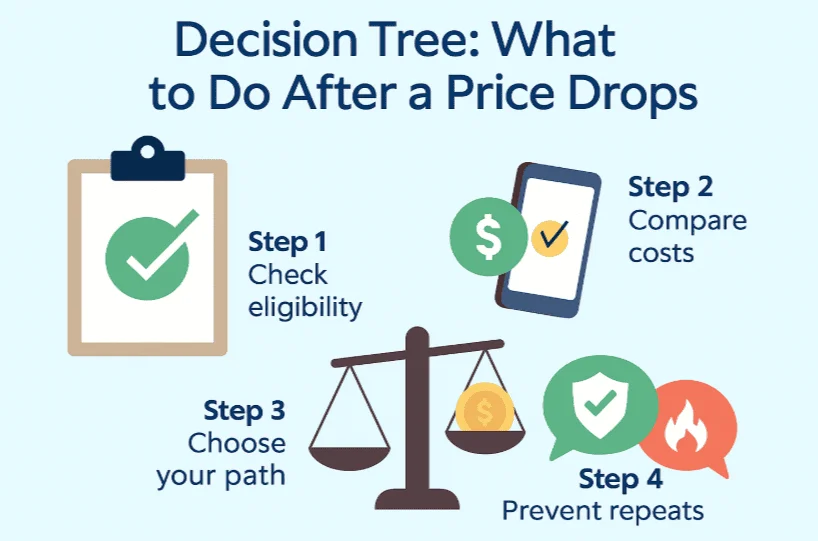
Step 1 — Check eligibility
Confirm the item is returnable and that you’re still inside the return window shown under Your Orders. If the item is non‑returnable (hazmat, perishable, digital), skip to courtesy request.
Step 2 — Compare costs
Estimate the savings from the lower price versus the time or shipping hassle of a return (many returns are drop‑off and free, but some oversized items can be inconvenient). If savings are small, consider keeping the item and submitting the “lower price” feedback for next time.
Step 3 — Choose your path
Return & re‑buy: Most reliable. Place a new order at the lower price, then start a return on the first order. Do not use the item if you intend to return it.
Courtesy credit request: Start a quick chat. Keep it friendly and brief; explain the timeline and ask whether a one‑time courtesy credit is possible. If declined, thank them and end the chat.
Step 4 — Prevent repeats
For price‑volatile categories (electronics, small appliances), watch prices for a few days before purchasing, and consider buying during the major sales windows you care about. If you pre‑order, look for the guarantee language so you’re covered automatically.
Do’s and Don’ts
Do take screenshots with timestamps when you notice a drop (helps agents verify).
Do check whether your item was sold and shipped by Amazon or by a third‑party merchant — the latter often means stricter return logistics.
Do be polite and concise during support chats; agents have limited discretion.
Don’t insist that Amazon has a “policy” to match prices — it doesn’t. Asking for a one‑time courtesy is more accurate (and effective).
Don’t open multiple chats to fish for a different answer; repeated attempts can backfire.
Don’t keep or use the first item if you plan to return & re‑buy.
Real‑World Examples (What Usually Happens)
Example 1 — $15 difference on a small appliance
You bought a $59.99 air fryer yesterday; today it’s $44.99. Chat support declines a price match but offers a $10 courtesy credit to avoid a return. You accept. (Outcome depends on timing and agent discretion.)
Example 2 — Big post‑event drop on headphones
After Prime Day, the price drops further by $30. You’re still within the return window. You initiate a return and re‑buy at the lower price — the reliable route when the numbers justify the effort.
Example 3 — Pre‑ordered video game
You pre‑ordered a game that fluctuated in price multiple times before release. On release day, your charge reflects the lowest pre‑release price automatically because the product page displayed the guarantee.
Glossary
Amazon price match policy
Amazon’s published stance that it does not match competitor prices or its own prior prices on demand. See the policy help page.
Amazon price match guarantee
Common (but imprecise) phrase people use online. The only formal guarantee Amazon describes is the Pre‑Order Price Guarantee on qualifying pre‑orders.
Courtesy credit
A goodwill credit or partial refund an agent may offer at their discretion — not a right, not policy. If you’d rather not chat manually, Task Monkey can automate polite requests.